
Why You Should Train in All Three Planes of Motion

Our bodies were designed to move in three dimensions, yet many of us spend our days moving in only one or two. We walk forward, sit, stand, and exercise in repetitive patterns, leaving entire movement capacities underused. By intentionally training in all three planes of motion, you'll improve mobility, build more resilient joints, increase stability, and reduce your risk of injury. By incorporating all three planes of movement into your routine, you will increase your range of motion, prevent injuries, and provide greater stability throughout your body.
The easiest way to understand the planes of motion is to imagine sheets of glass bisecting your body in 3 different places that your body can pass/move through.
Sagittal Plane
The Sagittal Plane of motion runs from side to side and you pass through it when moving forwards or backwards. Imagine the sheet of glass running right down the centerline of your body dividing your left and right sides evenly. Some movements in this plane include: running, walking, using elliptical, bicep curl, situps, deadlifts, reverse lunge, etc.
Extension and flexion happen in this plane. We spend a lot of time in this plane as we sit with the hips and knees in flexion. And then if we have poor posture and round our shoulders and spine forward, now the spine spends a lot of time in flexion too! That’s why I try to incorporate some type of back extension, like supermans or I-s and Y-s into my workouts.
Frontal Plane
The frontal, or coronal, plane of motion runs down the center of your body and you pass through it when moving from side to side. Imagine the sheet of glass bisecting your body down the center and dividing your body from front to back. Movements in this plane include ADDuction (moving arms and limbs toward the center of the body) and ABduction (moving arms or legs AWAY from the centerline of the body).
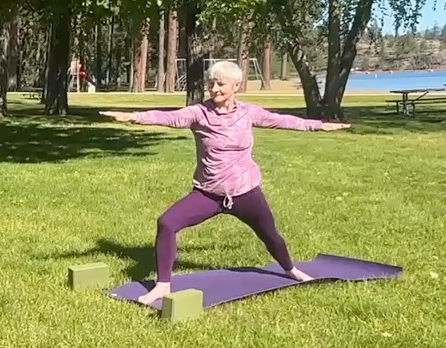
Some examples of frontal plane movements are: jumping jacks, speed skating, side lunges, lateral arm raises, lateral stepping movements, and side bends. Many of our modern daily movements include very little abduction, as our daily activities keep our arms and legs close to the midline of our body. We rarely move side-to-side, even though those movements are essential for maintaining healthy hips, knees, ankles, and balance.
Transverse Plane
The transverse plane of motion sits through the center of the body and you pass through it when rotating. Imagine the sheet of glass bisecting your body horizontally dividing you from top to bottom. This plane is a little trickier to visualize because it includes any rotational movement around a joint—not just twisting your torso. Any time we rotate a joint we are moving along the transverse plane. In daily life, this is the action we typically do least frequently, particularly with the large joints in the hips, shoulders, and spine.
Examples of transverse plane movements include torso twist with medicine ball or band, wood chops, T-pushups, or windshield wipers, throwing a baseball, golfing and swinging a bat.
We can use the Three planes of motion even when we’re NOT moving.

Isometric Hold in the Frontal Plane
Standing on one leg while holding a weight overhead is a great example of your body's ability to withstand forces in the frontal plane. While you're working to keep the weight stable, your core, hips, shoulders, and feet are all making tiny adjustments to prevent you from tipping or collapsing.
Building this kind of multi-planar stability is incredibly valuable because real life isn't predictable. Whether you're stepping off a curb, hiking on uneven terrain, carrying groceries, or catching yourself from a stumble, your body has to react to forces coming from every direction. The stronger your ability to resist those forces, the better your joints function and the lower your risk of injury.
We Can Also Train Our Ability to STOP Movement
Movement is only half of the equation. The other half is learning to control or resist movement.
Many injuries don't happen because we're unable to move—they happen because we're unable to control unwanted movement. Every time you carry a heavy suitcase in one hand, lift a child, shovel snow, or slip on an icy sidewalk, your muscles are working to keep your body from twisting, bending, or collapsing.
Exercises that resist movement are known as anti-rotation, anti-lateral flexion, or anti-extension exercises. These movements challenge your core and stabilizing muscles to maintain proper alignment while outside forces try to pull you out of position.
For example, during a standing wood chop, your core doesn't just create rotation—it also works to slow, control, and eventually stop the momentum of the weight. Likewise, a side plank teaches your body to resist bending sideways, while a Pallof press challenges you to prevent rotation altogether.
Developing this type of control creates stronger, more resilient joints, improves balance, enhances athletic performance, and better prepares your body for the unexpected movements of everyday life.
Example of Resisting movement: A standing wood chop exercise where you engage your core to stop the cross motion of the weight toward your hip.
Multi-Planar Movements
Most major muscle groups function in more than one plane of motion. Take the glutes, for example. They extend the hip (sagittal plane), abduct the hip (frontal plane), and externally rotate the hip (transverse plane). To fully strengthen a muscle, we should challenge it through all of the actions it's designed to perform.
A movement that combines two planes is called multi-planar, while one that incorporates all three is considered tri-planar. Many of the movements we perform in sports and everyday life naturally involve multiple planes at once.
Functional movements, like a squat is a great example. Although we often think of it as a sagittal-plane exercise, but a squat with a little lateral knee drive also includes frontal-plane stabilization as the knees track outward and transverse-plane hip rotation. That's just one of the many reasons I love squats—there are so many ways to do them, depending on your goals and body's unique needs.
Putting it all Together
While this article might have gotten a little more technical than you prefer, I hope this helps you to think about the types of movements you are incorporating in your workouts.
If for example you typically use the Elliptical for a half hour every day, and you are having pain in the front of your hip or knee. This movement, like most of our daily movements is in the Sagittal Plane. By incorporating more Frontal Plane and Transverse movements and stretches would help to provide more balance in the way your joints are moving, thus helping to reduce pain.
Try these Multi-Planar Workouts:
Medicine Ball 20 Min. AMRAP
(As Many Rounds As Possible in 20 minutes)
10 Squat and Press (Sagittal and frontal)
10 Lunge and twist (Sagittal and transverse)
10 Plank Knee to Elbows ( transverse)
25 Jumping Jacks (Frontal)
Medicine Ball Workout Video:
Sandbag Workout
4 rounds
60 sec. Plank Pull Through & Row (Sagittal and transverse)
60 sec. Sandbag Slam (Sagittal & frontal)
60 sec. Side plank leg lift( frontal)
60 sec. Speedskaters (frontal & transverse)
Sandbag Workout Video:
1 Dumbbell Tri-Planar wORKOUT
*3 rounds (20-16-10 reps)
(if exercise is bilateral do indicated # for each side)
Woodchops (Tri-planar)
T Plank (Sagittal, Transverse)
Plea Squat (Frontal)
Superman Swimmers (Sagittal)
Mountain Climbers with knees to opposite Elbows (tri-planar)
Dumbbell workout video:



Comments